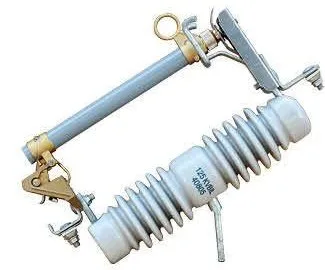
RW12 · RW12-15 · RW12-35 · RW33-15 · RW12-15F
Drop-out fuse cutouts
Outdoor high-voltage drop-out fuses and load-break drop-out fuses, installed on the HV side of distribution transformers or on line tee-offs to protect against short circuits and overloads. On operation the fuse carrier drops open, providing a visible isolating gap.
General information
Drop-out fuses and load-break drop-out fuses are outdoor high-voltage protective devices. They are installed on the high-voltage side of distribution transformers or on branches of distribution lines; they serve to protect transformers and lines against short circuits and overloads, as well as for making and breaking load current.
The fuse consists of an insulating support and a fuse carrier: the fixed contacts are mounted at both ends of the support, the moving contacts at both ends of the carrier. The carrier consists of an inner arc-quenching tube and an outer epoxy-glass tube. The load-break drop-out fuse additionally has spring auxiliary contacts and an arc chute for making and breaking load current.
Operating principle
In normal operation the carrier is held in the closed position by the tension of the fuse link. In the event of a fault, the short-circuit current quickly melts the link and an arc is formed. Under the action of the arc, the arc-quenching tube heats up and releases a large amount of gas; the pressure in the tube rises sharply, a longitudinal blast forms along the tube, and the arc is quickly elongated and extinguished. After the link blows, the lower moving contact loses tension and swings down, the latching mechanism releases the link and the carrier drops — a clearly visible gap is formed.
To break the load, the operator moves the moving contact away with an insulated hot stick: the main contacts open while the auxiliary contacts still remain closed. With further movement of the stick, the auxiliary contacts also open; the arc between them is elongated in the narrow slot of the arc chute, which releases gas, and the arc is extinguished at current zero.
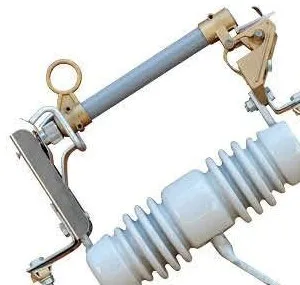
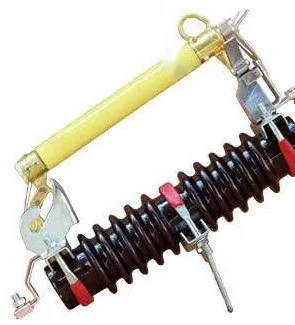
Type designation
| H | Composite insulating support (without H — porcelain support) |
| x | RW — standard drop-out fuse; PRWG — modified; RXWO — current-limiting |
| x | Design serial number |
| x | Rated voltage, kV |
| x | Rated current, A |
Service conditions
- Ambient temperature: not higher than +40 °C, not lower than −30 °C.
- Altitude: not more than 1000 m (above 1000 m — with altitude correction of insulation parameters).
- System frequency: 50 ± 2 Hz.
- Seismic intensity: up to and including 7 degrees.
- Maximum wind speed: 35 m/s.