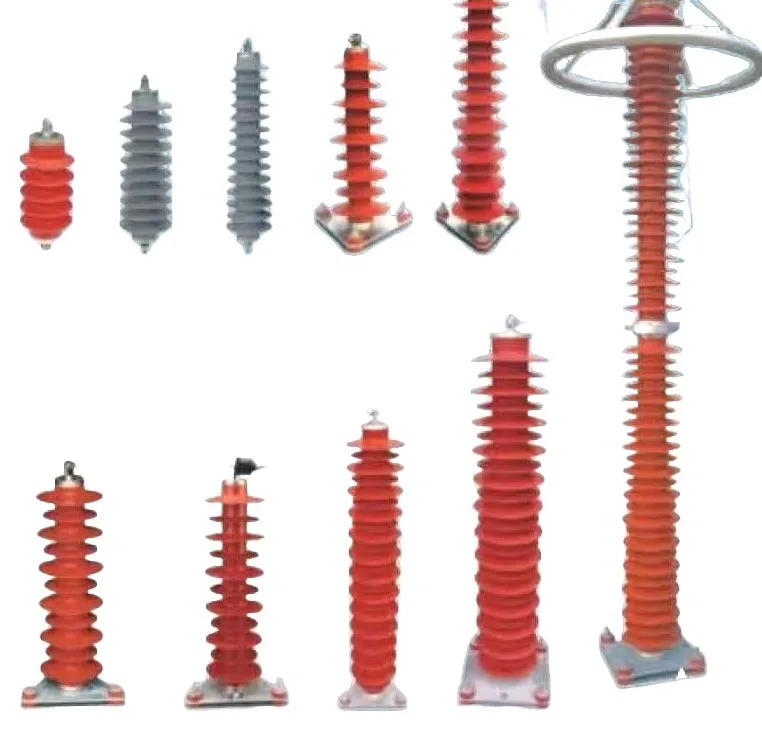
MOA
Metal-oxide surge arresters
Zinc-oxide (metal-oxide) surge arresters for AC generation, transmission and distribution systems up to and including 220 kV. They limit lightning and switching overvoltages and form the basis of equipment insulation coordination.
Key parameters
- System voltage
- up to 220 kV
- System frequency
- 50 ± 2 Hz or 60 ± 2 Hz
General information
Surge arresters are the basis of insulation coordination for all medium- and high-voltage electrical equipment in a power system: transformers, reactors, capacitors, generators, electric motors, voltage transformers (VT) and current transformers (CT), circuit breakers, contactors, etc. The protective characteristics of the arrester determine the internal and external insulation levels of all equipment (short-duration power-frequency withstand voltage, lightning and switching impulse withstand voltage, etc.).
The metal-oxide surge arrester (Metal-Oxide Surge Arrester, hereinafter — MOA) is the most advanced type among conventional arresters. Its main active element is made by sintering a multi-component zinc-oxide-based metal-oxide ceramic; it has an excellent non-linear voltage-current characteristic, responds quickly to steep-fronted waves and has a high energy absorption capability.
Application
MOA arresters are used in AC power generation, transmission, transformation and distribution systems with voltages up to and including 220 kV and limit the amplitude of lightning and internal switching overvoltages to a specified level. They are the basic equipment for insulation coordination of the entire system. At the same time, the product is not intended for limiting resonant overvoltages — other means should be used to counter resonance in the system.
Service conditions
- Ambient temperature: −40 °C … +40 °C.
- Altitude: ≤ 2000 m; high-altitude version — for altitudes above 4000 m.
- System frequency: 50 ± 2 Hz or 60 ± 2 Hz.
- Seismic intensity: ≤ 7 degrees.
- Maximum wind speed: 35 m/s.
- Without cleaning (maintenance-free version): for areas with medium and lower pollution levels.
- For gapless arresters: the continuous power-frequency voltage must not exceed the maximum continuous operating voltage of the arrester (Uc).
- For arresters with gaps: the power-frequency voltage at the installation point must not exceed the rated voltage of the arrester (Ur).